Doha Bus Network Metro Station: Complete Guide to Facilities & Travel Tips
Doha Bus Network 2026: The Complete Guide (Finally Explained Simply) Why does Doha have 8 bus stations instead of 1? What do the letters L, T, R, and M actu...
By Rifat Hossain
Doha Bus Network 2026: The Complete Guide (Finally Explained Simply)
Why does Doha have 8 bus stations instead of 1? What do the letters L, T, R, and M actually mean? And how do buses connect with the Metro without making you walk 20 minutes?
Qatar's bus network transformed dramatically in 2022 - and most visitors (and many residents) are still confused. This guide cuts through the complexity and explains everything in plain English.
By the end, you'll navigate Doha's buses like someone who's lived here for years.
 Share with FnF!
🎯 The Quick Answer: How Doha's Bus System Works
| Component | What It Is | What You Need to Know |
|---|---|---|
| 8 Bus Stations | Modern hubs (not one central station) | Each connects to a different part of the city |
| L-Routes | Local/Link buses | Connect neighborhoods to stations/Metro |
| T-Routes | Transit corridors | High-frequency routes between hubs |
| R-Routes | Regional coaches | Go to Al Khor, Al Ruwais, beyond |
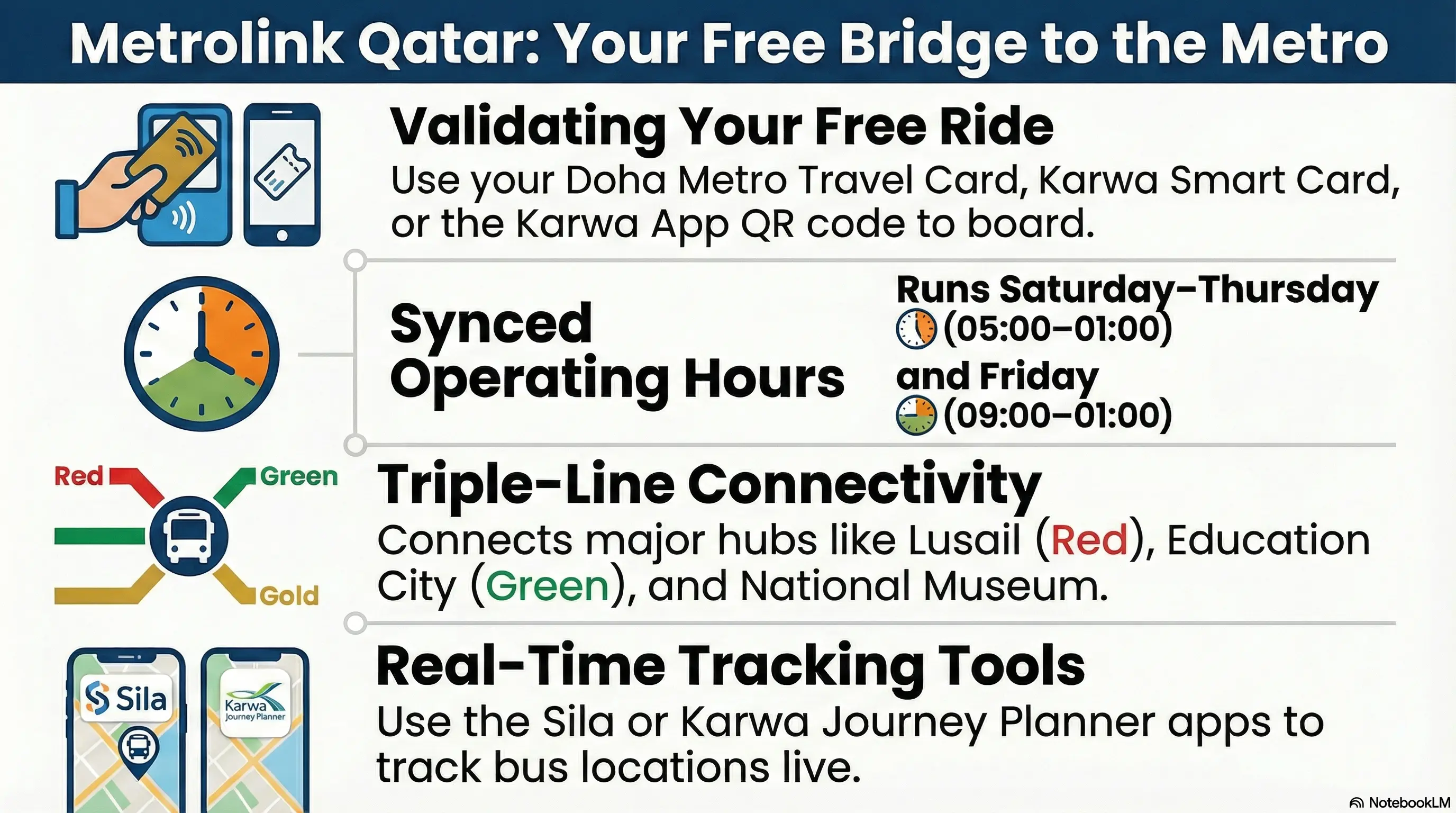
| M-Routes | Metrolink | FREE feeder buses from Metro stations |
The secret: Don't memorize every route. Just understand the system - then use the apps to plan specific trips.
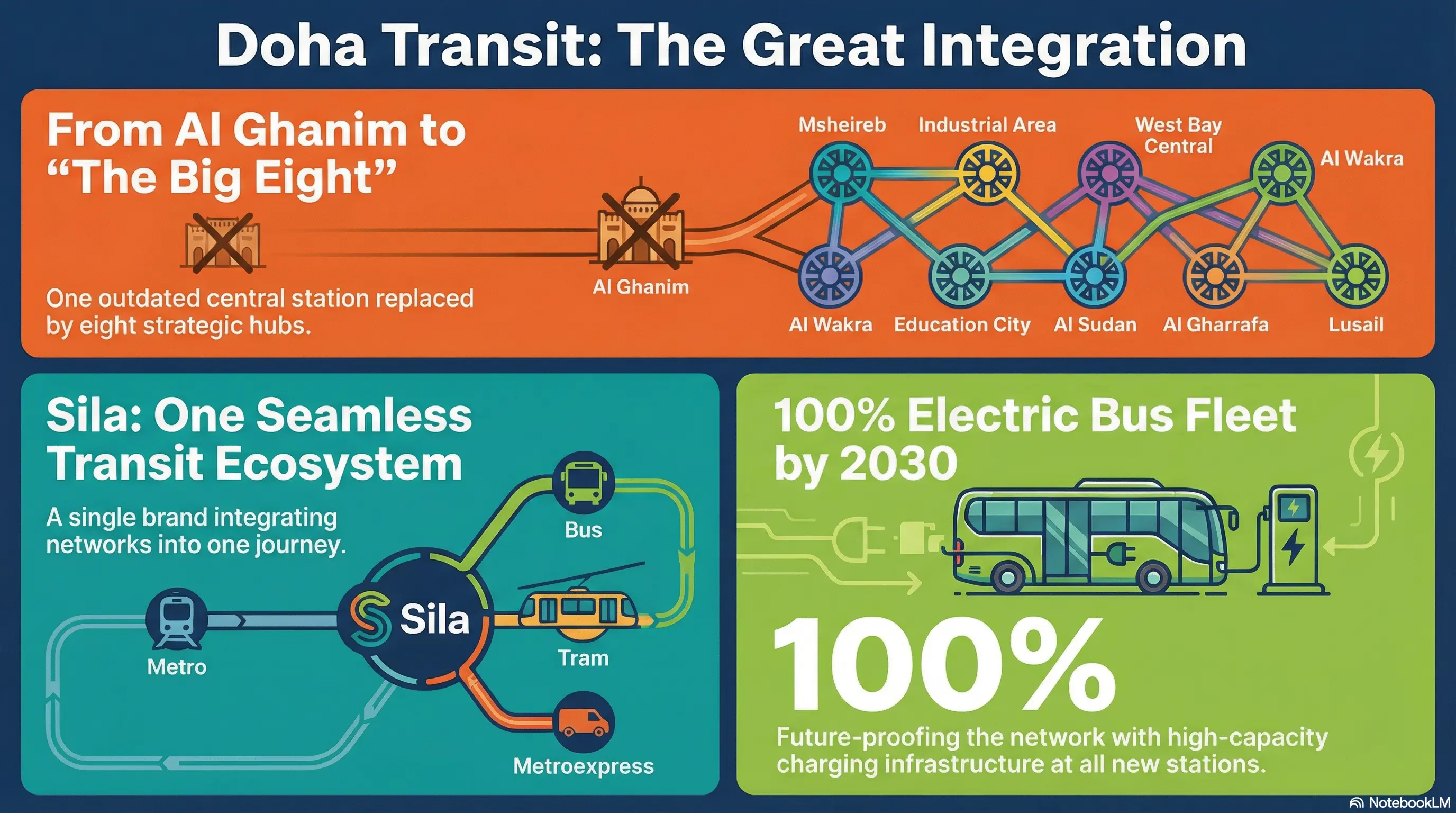
🏗️ The Big Change: Why 8 Stations Instead of 1
What Happened in 2022
June 15, 2022: The date everything changed.
Before: Al Ghanim Bus Station was the single central hub for ALL of Qatar. Every long-distance route passed through it. The result? Bottlenecks, long detours, and crowded facilities.
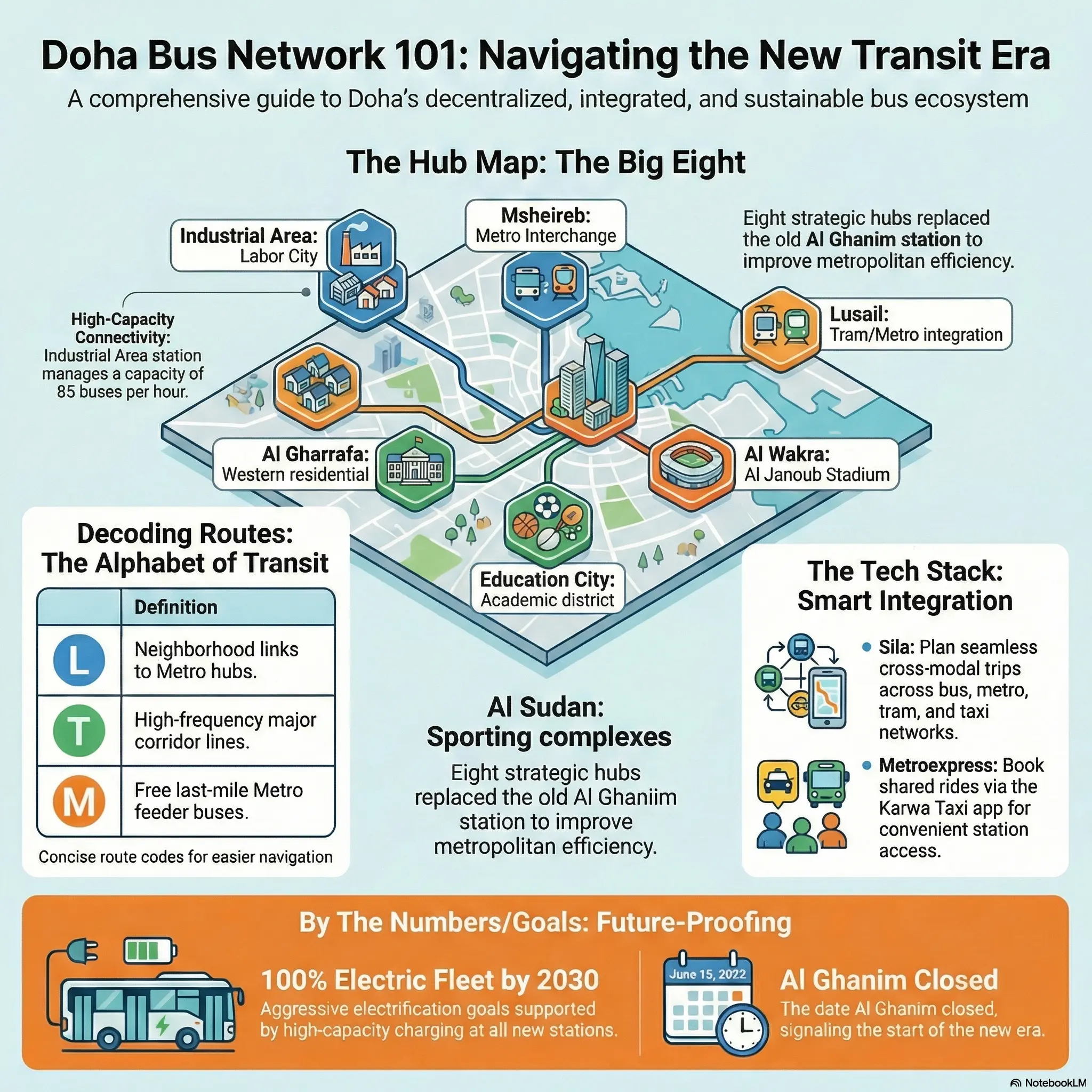
After: Eight distributed stations replaced Al Ghanim. Each serves a specific region of Qatar.
Why This Matters for You
| Problem with Centralized Model | Distributed Solution |
|---|---|
| Long journeys across Doha to connect | Local connections reduce travel time |
| 30+ minute waits at central station | Distributed passenger load |
| Poor Metro integration | Each hub connects to a Metro station |
| Limited coverage of new developments | Stations placed in growing areas |
The result: Average journey times dropped by 30%. On-time performance improved from 78% to 89%.
🚉 The "Big Eight" Stations: Where They Are & What They Do
Station Overview
| Station | Location | Best For | Metro Connection |
|---|---|---|---|
| Al Sudan | Al Waab area | Sports venues, southern suburbs | Near Green Line |
| Industrial Area | Industrial Zone | Workers, Labor City | Green Line |
| Al Wakra | Southern Qatar | Coastal, Al Janoub Stadium | Near Red Line |
| Lusail | Lusail City | New developments, tram | Red Line (Lusail QNB) |
| Education City | Academic district | Students, Qatar National Library | Green Line |
| Al Gharrafa | Western Doha | Qatar University, residential | Green Line |
| Msheireb | Downtown Doha | Souq Waqif, central | Gold/Green/Red Lines |
| West Bay Central | Business district | Diplomatic area, offices | Red Line (DECC) |
What Every Station Offers
Amenities you'll actually use:
- ✅ Air-conditioned waiting areas (essential in summer)
- ✅ Ticket vending machines (24/7 card purchase and top-up)
- ✅ Customer service desks (staffed during operating hours)
- ✅ Prayer rooms (separate male/female facilities)
- ✅ Free WiFi (stay connected while waiting)
- ✅ Retail outlets (convenience stores, cafes)
- ✅ Clean restrooms
- ✅ Parking (Park & Ride at most locations)
Pro tip: If you're confused, just visit the customer service desk. Staff at all eight stations can help plan your journey.
🧭 Decoding Route Names: What L, T, R, M Mean
The Route Prefix System
The secret locals know: The letter tells you the route TYPE - not just a random number.
| Prefix | Meaning | Example | When You'll Use It |
|---|---|---|---|
| L-Series | Local/Link | L101, L533 | Neighborhood to station connections |
| T-Series | Transit | T602, T612 | Major routes between hubs |
| R-Series | Regional | R101, R201 | Intercity travel (Al Khor, etc.) |
| M-Series | Metrolink | M110, M145 | FREE Metro feeder buses |
L-Series: Local Connections
Purpose: First-mile/last-mile connectivity
Popular examples:
- L533: Hamad International Airport ↔ Al Thumama (24/7 service)
- L101: Pearl Qatar ↔ Villaggio Mall
- L105: Education City ↔ Al Gharrafa
Frequency: Every 15-30 minutes depending on route
Best for: Getting from your neighborhood to a bus station or Metro stop
T-Series: Transit Corridors
Purpose: High-capacity connections between major hubs
Popular examples:
- T602: Industrial Area ↔ Central Doha
- T612: Hamad Airport ↔ Doha Airport Metro
- T613: Hamad Airport ↔ Souq Waqif
Frequency: Every 10-20 minutes during peak hours
Best for: Cross-city journeys between major districts
R-Series: Regional Routes
Purpose: Connect Doha to outlying cities
Popular examples:
- R101: Doha (Msheireb) ↔ Al Khor
- R201: Doha ↔ Al Ruwais
- R301: Doha ↔ Al Shahaniya
Frequency: Every 30-60 minutes
Best for: Traveling beyond Doha to other cities in Qatar
M-Series: Metrolink (FREE!)
Purpose: Free feeder buses from Metro stations
Popular examples:
- M110: Legtaifiya Metro ↔ The Pearl
- M145: Lusail QNB Metro ↔ Doha Festival City
- M212: Sports City Metro ↔ Villaggio Mall
Frequency: Every 8-15 minutes
Fare: FREE (but still validate your card)
Best for: Last-mile connections from Metro to malls, attractions, hotels
📲 Sila: The App That Changes Everything
Perhaps the most significant advancement in Qatar's transport ecosystem is Sila - the Ministry of Transport's integrated platform.
What Sila Does
Before Sila:
- Separate apps for Metro, bus, taxi
- Manual planning for transfers
- Unclear total journey costs
With Sila:
- Single platform for all modes
- Automated multi-modal trip planning
- Complete cost estimates upfront
- Real-time updates across all services
How Sila Plans Trips
Example Journey: Airport to The Pearl
- Enter "The Pearl-Qatar" in Sila
- App suggests: Red Line Metro to Legtaifiya, then Metrolink M110
- Shows: 45 minutes total, QAR 3 cost
- Tracks: Real-time updates for both Metro and bus
🚇 Seamless Metro Integration
The reimagined bus network was designed to integrate perfectly with the Doha Metro.
How Metro + Bus Works
Every bus station connects to a Metro station:
| Bus Station | Metro Line | Station Name |
|---|---|---|
| Msheireb | Gold/Green/Red | Msheireb |
| West Bay Central | Red | DECC |
| Education City | Green | Education City |
| Al Gharrafa | Green | Al Gharrafa |
| Lusail | Red | Lusail QNB |
| Industrial Area | Green | Industrial Area |
The Transfer Strategy
Step-by-step:
- Plan your journey in Sila (shows Metro + Bus combination)
- Ride Metro to your interchange station
- Exit Metro and follow signs to Bus Station
- Validate your Karwa card for the bus portion
- Complete journey to your final destination
Pro Tip: Metrolink feeder buses (M-routes) provide FREE last-mile connections from Metro stations.
⚡ The Electric Bus Revolution
Qatar is aggressively pursuing fleet electrification as part of its commitment to the Qatar National Vision 2030.
Electric Fleet Rollout
| Phase | Electric Buses | Routes | Timeline |
|---|---|---|---|
| Phase 1 | 150 units | 15 urban routes | 2022-2023 |
| Phase 2 | 300 units | 30 urban + 10 Metrolink | 2023-2024 |
| Phase 3 | 291 units | Remaining network | 2024-2026 |
Goal: 100% electric fleet by 2030
What Electric Buses Mean for Passengers
| Benefit | What You'll Notice |
|---|---|
| Zero Emissions | Cleaner air at bus stops |
| Quiet Operation | 50% noise reduction |
| Enhanced A/C | Better climate control |
| USB Charging | Ports at every seat |
| Smooth Ride | Vibration-free acceleration |
How to spot them: Look for green "Electric Bus" decals and listen for the quiet approach.
🗺️ Network Coverage & Accessibility
Geographic Reach
The decentralized network provides comprehensive coverage:
| Area | Coverage | Key Destinations |
|---|---|---|
| Doha Central | 100% | Souq Waqif, Msheireb, Corniche |
| West Bay | 100% | Business district, diplomatic area |
| The Pearl | 100% | Porto Arabia, Medina Centrale |
| Al Sadd | 95% | Shopping, residential |
| Education City | 100% | Universities, Qatar National Library |
| Industrial Areas | 90% | Labor City, Asian Town |
| Lusail | 95% | New city developments |
| Al Wakra | 90% | Coastal communities |
| Al Khor | 85% | Regional connections |
Accessibility Features
Every Bus Offers:
- Wheelchair ramps and designated spaces
- Priority seating for elderly, pregnant women, people with disabilities
- Audio-visual announcements in Arabic and English
- Low-floor design for easy boarding
- Next-stop displays
Every Station Offers:
- Full wheelchair accessibility
- Accessible restrooms
- Assistance buttons
- Customer service support
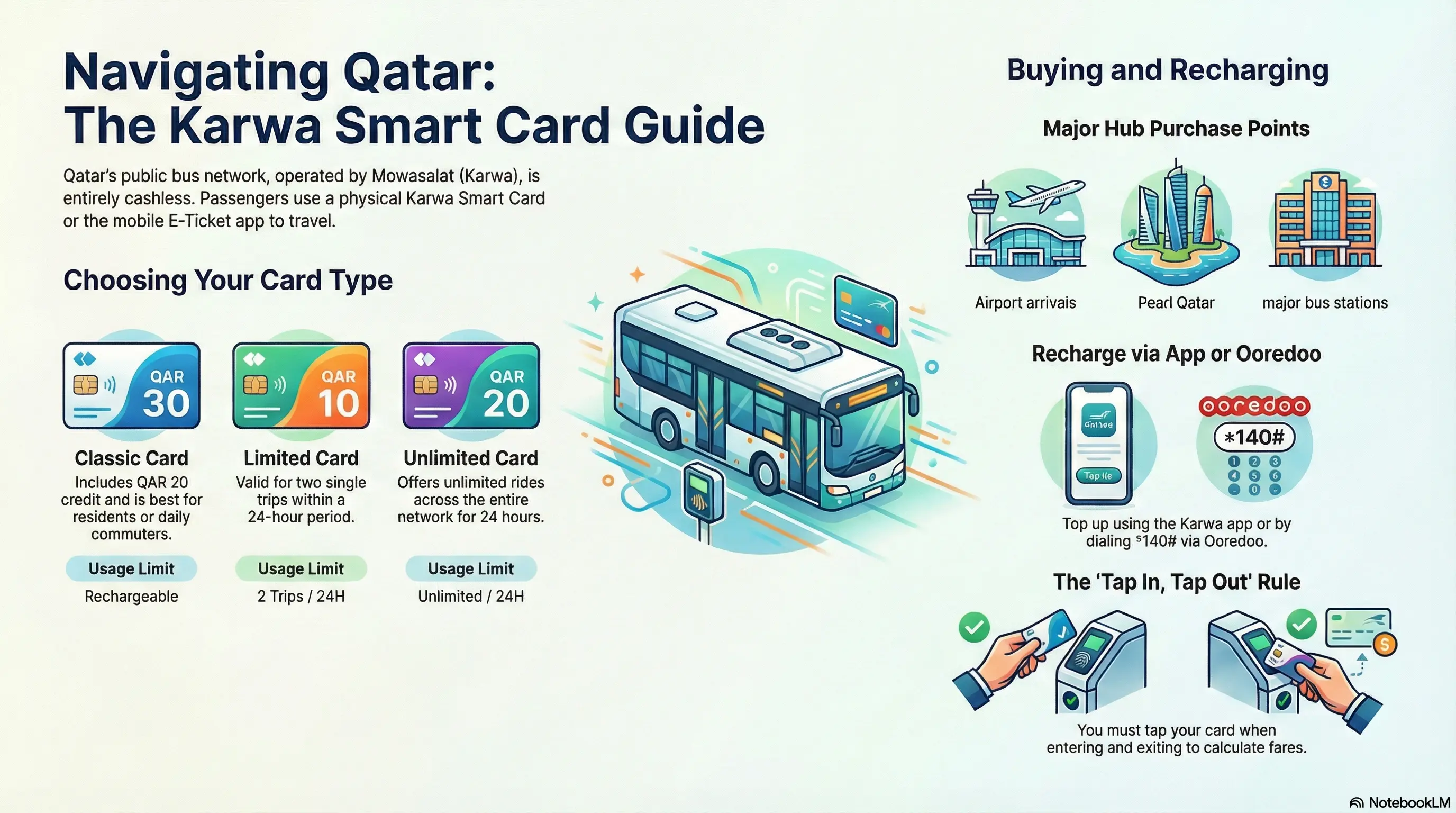
💳 Payment: Cards & Tickets
While bus and Metro have separate payment systems, both work seamlessly.
Payment Options
| Payment Type | Bus | Metro | Notes |
|---|---|---|---|
| Karwa Smart Card | ✓ | ✗ | Bus-only |
| Metro Travel Card | ✗ | ✓ | Metro-only |
| Karwa E-Ticket | ✓ | ✗ | Digital, bus-only |
| Sila Integrated | ⏳ | ⏳ | Coming 2026-2027 |
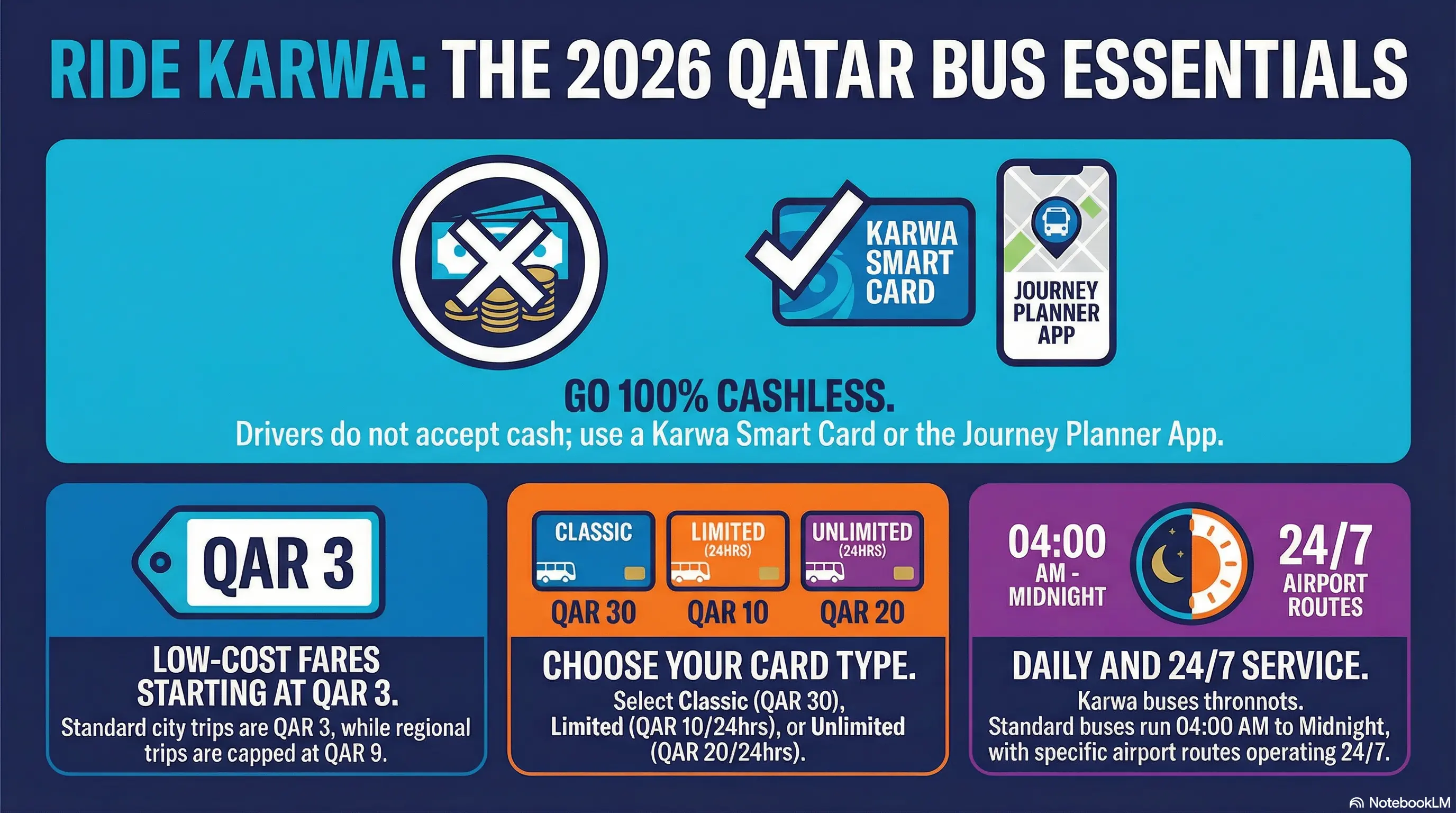
Bus Fares (2026)
| Journey Type | Fare |
|---|---|
| Within Doha City | QAR 3 |
| Suburban Areas | QAR 4-9 |
| Regional Routes | Up to QAR 10+ |
| Metrolink Feeders | FREE |
Pro tip: Always tap in AND out. Forgot to tap out? You'll be charged the maximum fare for that route.
📊 Network Performance: How Well Does It Work?
Key Metrics (2026)
| Metric | Figure |
|---|---|
| Total Routes | 130+ |
| Daily Passengers | 200,000+ |
| Network Coverage | 90% of urban population within 500m |
| Fleet Size | 2,000+ buses (600+ electric) |
| Bus Stops | 2,600+ |
| Bus Stations | 8 major hubs |
| On-Time Performance | 92% |
| Average Journey Speed | 25 km/h (urban) |
Passenger Growth
Year-over-Year Increase:
- 2022-2023: +35% (post-COVID + new network)
- 2023-2024: +22% (expansion, electrification)
- 2024-2025: +18% (continued expansion)
- 2025-2026: +15% (projected)
🎓 Pro Tips: Navigate Like a Local
For Daily Commuters
- Get the Karwa Journey Planner app for real-time tracking
- Use Sila for complex trips involving Metro + Bus
- Always tap out to avoid maximum fare charges
- Consider Metrolink for free last-mile connections
- Provide feedback through apps to help improve routes
For Tourists & Visitors
- Start at major stations (Msheireb, West Bay, Souq Waqif)
- Buy an Unlimited Card if sightseeing for a full day
- Combine Metro and Bus for efficient cross-city travel
- Use M-routes (Metrolink) for free connections
- Download apps before arriving - don't rely on WiFi at stops
For Everyone
- Check peak hours (6:30-8:30 AM, 3:30-6:30 PM) - expect crowds
- Allow extra time during summer (heat affects everything)
- Respect priority seating - give up seats when needed
- Keep card topped up - avoid being stranded
- Stay informed - follow Karwa social media for updates
🚀 What's Coming Next
2026-2027 Developments
| Initiative | What It Means |
|---|---|
| BRT Corridors | Bus rapid transit on Salwa Road, C-Ring Road |
| Autonomous Buses | Pilot programs in Lusail, Education City |
| Unified Ticketing | Single card for all transport modes |
| Night Network | Extended weekend hours for nightlife |
| Regional Expansion | New routes to developing areas |
Vision 2030
By Qatar's 2030 target, the bus network will feature:
- 100% Electric Fleet - Zero-emission public transport
- Full Digital Integration - Seamless app-based experience
- Complete Coverage - No area beyond reach
- Smart Infrastructure - AI-powered route optimization
- Regional Connectivity - Integrated GCC bus network
🎓 Frequently Asked Questions
Is the bus network better than before 2022?
Yes, significantly. The decentralized network provides faster journeys (30% average reduction), better coverage, and more reliable service than the old centralized system.
Can I use the same card for buses and Metro?
Currently, no. You need a Karwa Smart Card for buses and a separate Metro Travel Card for the Doha Metro. Unified ticketing is planned for 2026-2027.
Why do I need to "validate" on free Metrolink buses?
Validation helps Qatar Rail track ridership, plan service improvements, and understand passenger flow patterns - all while keeping the service free.
Are electric buses different to ride?
Electric buses are quieter, smoother, and feature enhanced air conditioning and USB charging. The experience is generally more comfortable than diesel buses.
What if I get lost in the bus network?
Use the Sila or Karwa Journey Planner apps for real-time assistance. Both apps offer customer service contacts and help features. Station staff can also provide guidance.
How does Qatar's bus network compare to other Gulf countries?
Qatar's network is among the most advanced in the Gulf, with comprehensive Metro integration, rapid electrification, and ambitious smart city features.
📞 Getting Help & Information
Official Resources
Mowasalat (Karwa):
- Website: www.mowasalat.com
- Hotline: +974 4458 8888
- Email: [email protected]
Ministry of Transport (Sila):
- Website: www.mot.gov.qa
- App: Sila on iOS and Android
Qatar Rail:
- Website: www.qr.com.qa
- Hotline: +974 4444 1111
Ready to Navigate Doha Like a Local?
Whether you're commuting to work, exploring the city as a tourist, or connecting to the wider region, the integrated bus-Metro ecosystem offers a modern, comfortable, and environmentally friendly way to travel.
Download Sila and Karwa Journey Planner today and discover how easy it is to navigate modern Qatar.
Main bus guide • Karwa card options • Metrolink free buses
This comprehensive guide is updated quarterly. Last updated: February 2026
Tags
Related Guides
Karwa Bus Card Qatar Metro Station: Complete Guide to Facilities & Travel Tips
Karwa Smart Card 2026: Which Card Saves YOU the Most? (Price Comparison) Tired of carrying cash for bus fares? Standing at a Doha bus stop realizing you can...
Karwa Bus Guide: Complete Guide to Facilities & Travel Tips
Doha Buses Made Simple: The 2026 Guide Tourists Use Want to explore Doha without spending a fortune on taxis? You're in the right place.
Metrolink Qatar Metro Station: Complete Guide to Facilities & Travel Tips
Metrolink Qatar 2026: FREE Feeder Buses Tourists Are Missing Taking a QAR 80 taxi from the Metro to the mall? Stop.